
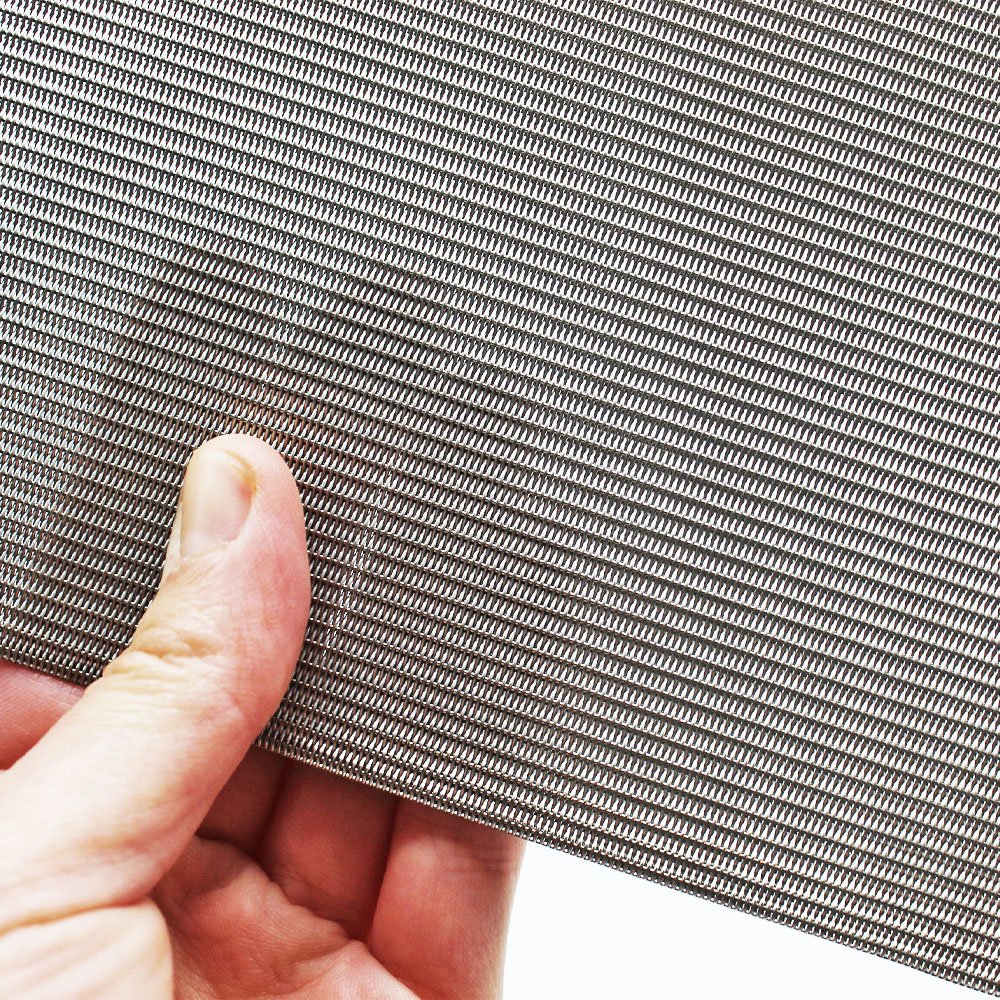
Two meshes can share the same mesh count and wire diameter yet behave completely differently in service. The difference is the weave — how warp and weft wires interlace. Here is what each common weave does, and where it belongs.
Plain weave
Each weft wire passes alternately over and under each warp wire — the simplest and most common pattern. It gives square, uniform openings, good stability and the lowest cost. Plain weave covers the majority of screening, sieving, protection and general filtration duties.
Twill weave
Each weft wire passes over two and under two warp wires in a staggered pattern, creating a diagonal appearance. Twill allows a finer mesh to be woven with relatively heavier wire than plain weave permits — the result is finer filtration combined with higher mechanical strength. Typical uses: fine screening, filtration of viscous media, and applications with mechanical load.
Plain Dutch weave
Coarse warp wires with fine, closely packed weft wires. The weft wires are driven tightly together so the mesh filters through the small triangular gaps rather than square openings. Plain Dutch weave delivers much finer filtration than its mesh count suggests, with excellent strength — a standard choice for liquid and gas filtration.
Twilled Dutch weave
Combines the twill pattern with Dutch-style dense weft packing. It achieves the finest filtration ratings of the woven meshes with very high strength and good cake-release properties. Used in high-pressure filtration, polymer and chemical processing, and aerospace hydraulics.
How to specify
When ordering, state the weave type explicitly along with mesh count and wire diameter — for Dutch weaves, give both warp and weft counts (e.g. 12×64). If you are unsure which weave your application needs, describe the fluid, the particle size to retain and the operating pressure in your inquiry, and we will recommend the right construction.